IT Support Hourly Rate: Freelancer vs. Agency vs. Retainer
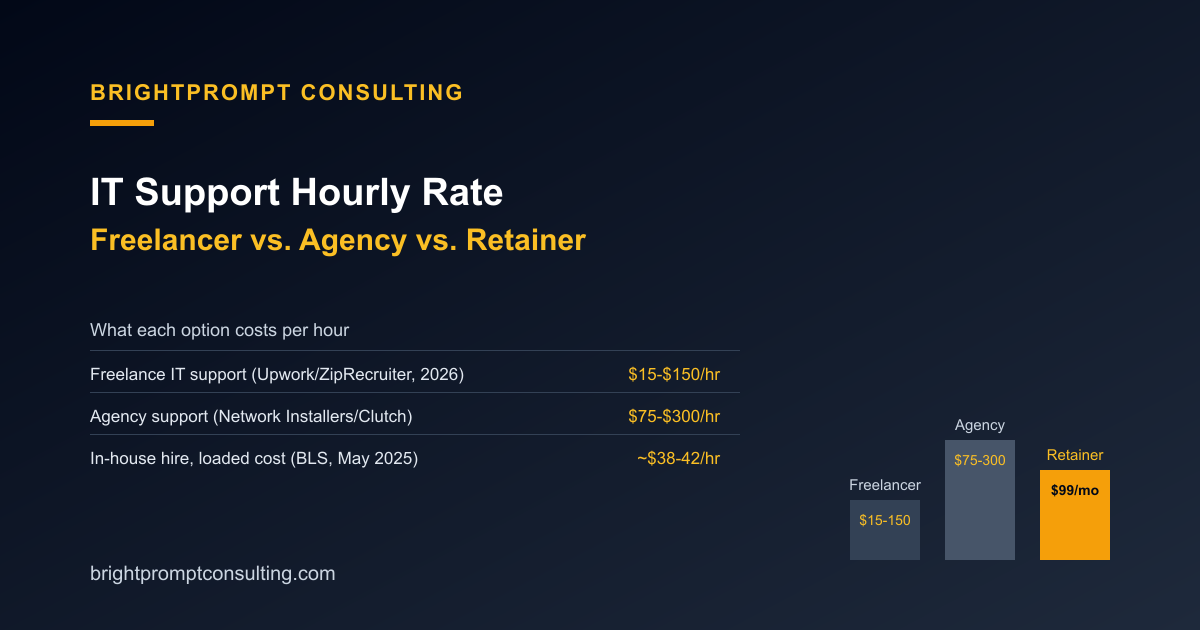
Freelance IT support typically runs $15 to $150 an hour depending on experience, IT agencies charge $75 to $300 an hour for outsourced break-fix work, and a flat monthly retainer often works out cheaper than either once you're using more than a couple of hours a month. Most of what ranks for this search is employee salary data, not what a business actually pays an outside provider, so here's the comparison those pages skip.
What Does a Freelance IT Support Rate Actually Look Like?
On Upwork, technical support agents list rates of $15 to $30 an hour with a median around $22, while independent IT consultants run $12 to $30 an hour with a median closer to $17, according to Upwork's September 2026 freelancer rate data. ZipRecruiter's broader 2026 freelance IT breakdown shows more range by seniority: entry-level freelancers at $40 to $60 an hour, mid-level at $60 to $90, and senior freelance IT consultants at $90 to $150 or more. The gap between those two sources comes down to scope: marketplace listings skew toward basic help-desk tasks, while the seniority-tiered numbers reflect consultants handling infrastructure or security work.
What Does an IT Support Agency Charge Per Hour?
Standard outsourced IT support from an agency runs $75 to $250 an hour, with emergency or after-hours work running as high as $300 an hour, according to The Network Installers' December 2025 cost breakdown. Clutch's September 2026 MSP pricing data lands in a similar range: $100 to $149 an hour for standard managed support, jumping to $250 to $500 an hour for emergency dispatch. Agencies price higher than most freelancers because the rate usually includes overhead a solo freelancer doesn't carry: a help desk, backup technicians, and liability coverage if something goes wrong.
| Option | Typical hourly rate | Source |
|---|---|---|
| Freelance (marketplace, basic) | $15-$30/hr | Upwork, Sep. 2026 |
| Freelance (by seniority) | $40-$150+/hr | ZipRecruiter, 2026 |
| Agency, standard | $75-$250/hr | The Network Installers, Dec. 2025 |
| Agency, emergency/after-hours | $250-$500/hr | Clutch, Sep. 2026 |
| Flat retainer (BrightPrompt) | $99/mo incl. 1 hr, $129/hr after | BrightPrompt Consulting |
Where Does an In-House Hire Fit Against These Numbers?
The median U.S. computer support specialist earns $62,890 a year, or about $30.24 an hour before payroll taxes, benefits, and overhead, according to the Bureau of Labor Statistics' May 2025 occupational wage data. Add the typical 25% to 40% loaded-cost markup employers carry for benefits and taxes, and a full-time hire's real effective rate lands closer to $38 to $42 an hour, for coverage during business hours only, with no backup if that person is out sick or on vacation. That's the baseline every outsourced option below gets compared against.
At What Point Does a Flat Retainer Beat Paying By the Hour?
Here's the breakeven math, worked from BrightPrompt Consulting's own $99-a-month retainer, which includes the first hour with additional hours at $129 each. One hour of support in a month costs $99, an effective rate of $99 an hour. Three hours costs $99 plus two overage hours, or $357, an effective rate of $119 an hour. Compare that to a mid-tier freelancer at $70 an hour: three hours of freelance work costs $210, cheaper in that single month, but with no monitoring, no proactive patching, and a new vendor relationship to manage every time something comes up. The retainer pulls ahead once a business consistently needs even occasional monitoring on top of ad hoc fixes. Most freelance or agency engagements don't sell that monitoring by the hour at all. A retainer bundles it in, or no one offers it.
Which Option Actually Fits a Small Business?
Rare, one-off issues, a printer that won't connect, a one-time server move, are usually cheaper handled by a freelancer at an hourly rate. Recurring need, anything that comes up more than once or twice a month, tends to favor a flat retainer once you add up the hours and factor in that a retainer typically bundles monitoring a freelancer won't. Our IT support price checklist covers the broader questions to ask before signing any pricing structure, hourly or flat, and our guide to small business IT consultant mistakes covers what goes wrong when a business picks the wrong model for how often it actually needs help.
Frequently Asked Questions
What is the average hourly rate for IT support?
Freelance IT support runs $15 to $150 an hour depending on experience and platform, according to Upwork and ZipRecruiter's 2026 data, while agencies charge $75 to $300 an hour for standard and emergency work, per The Network Installers and Clutch.
Is a freelancer or an agency cheaper for IT support?
Freelancers are usually cheaper per hour, often $15 to $90 an hour versus $75 to $250 for an agency, but agencies typically include backup coverage, a help desk, and liability protection that a solo freelancer doesn't carry.
Is managed IT support cheaper than paying hourly?
It depends on volume. A flat retainer like BrightPrompt's $99-a-month plan costs $99 for one hour of work, an effective $99 an hour, but the math improves the more hours are used in a month, and it bundles monitoring that hourly billing typically doesn't include at all.
How does an in-house IT hire's cost compare to outsourcing?
A full-time computer support specialist's loaded hourly cost runs roughly $38 to $42 an hour once benefits and taxes are added to the Bureau of Labor Statistics' $30.24 median hourly wage, for coverage during business hours only, with no backup when that person is unavailable.
When does it make sense to pay hourly instead of a flat retainer?
For rare, one-off problems, a single server migration, a printer that won't connect, hourly freelance pricing is usually the cheaper option. Once support needs become recurring, a flat retainer tends to win on total cost and adds proactive monitoring that hourly billing doesn't include.