IT Support Partner vs. Vendor: A Buyer's Checklist
An IT support partner is a provider that covers your network, website, and software under one ongoing retainer and stays engaged between problems, while a break-fix vendor shows up only when something breaks and bills by the incident. Almost every provider calls itself a "partner" on its homepage, so the real test is in the contract: what's covered, how often they check in, and what happens when nothing's on fire. Run any provider you're considering through the checklist below before you sign anything.
What Actually Separates a Partner From a Vendor?
A true IT partner is paid to keep things running, so the incentive points toward prevention. A break-fix vendor is paid once something is already broken, so the incentive points toward volume. That one difference explains most of what shows up day to day: how often they check in, whether they ask about your business goals, and whether your website and software fall under the same agreement as your network. Compexit's breakdown of the provider-versus-partner gap puts the test plainly: "Is an IT support provider likely to proactively seek that out for you? Probably not; they're reactive." That's the first filter worth applying to any quote.
How Common Is Outsourced IT, and Does It Actually Work?
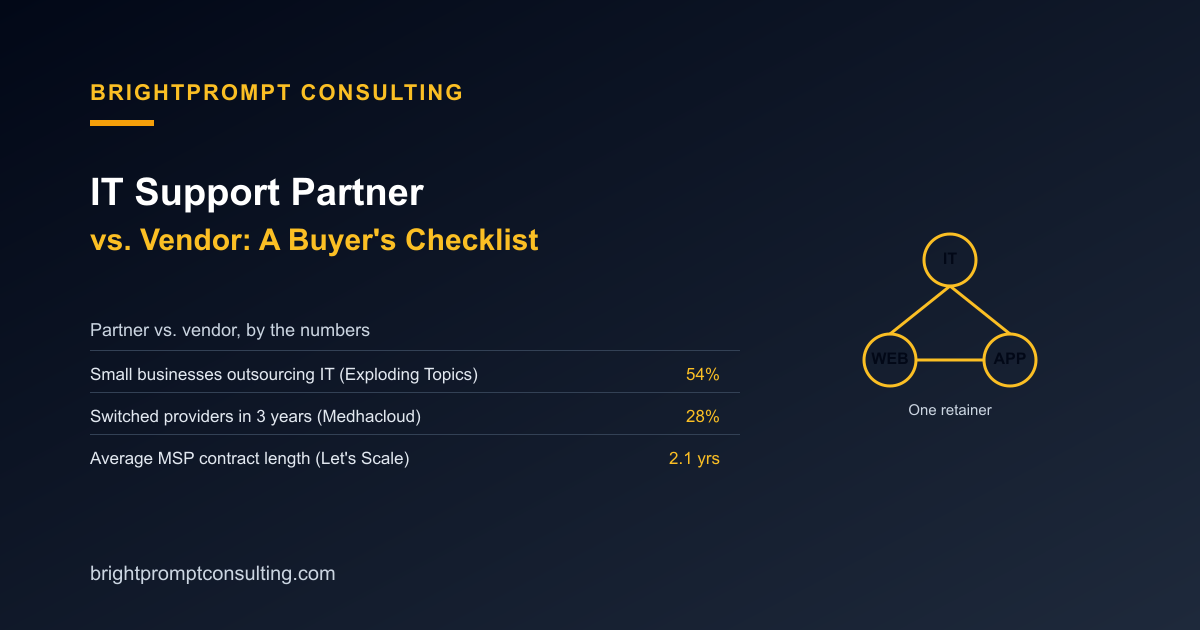
54% of small businesses now outsource at least some IT services, according to Exploding Topics' 2025 outsourcing statistics report, so the question for most owners isn't whether to outsource but who to outsource to. The payoff for picking well is measurable: businesses with outsourced IT report 45% fewer hours of unplanned downtime annually than those without it, per the same report. That gap is almost entirely a function of proactive monitoring, the kind a retainer-based partner runs continuously and a per-incident vendor doesn't run at all.
Why Do Businesses Switch Providers, and What Does That Tell You?
28% of managed IT clients switched providers within a three-year window, according to Medhacloud's 2026 managed services market statistics, and the top reasons were poor communication (41%), mishandled security incidents (33%), and pricing (28%). Technical skill barely registers on that list, which says the relationship itself, not the fix quality, is usually what breaks down first. The same data shows why that matters for retention: vertically specialized providers who understand a client's specific industry hold 38% higher client retention than generalist shops, and client churn for co-managed or advisory-style relationships runs under 5% annually versus an 8.4% industry average for standard managed service contracts.
| Signal | Break-fix vendor | IT support partner |
|---|---|---|
| When they engage | After something breaks | Continuously, before and after |
| Contract structure | Per-incident or hourly invoice | Flat monthly retainer |
| Scope | One ticket, one system | IT, web, and software under one agreement |
| Point of contact | Whoever's on shift | Same team every time |
| Typical contract length | None, or single job | 2.1 years on average, per Let's Scale's 2026 contract-length review |
What Does It Cost to Run Three Vendors Instead of One Partner?
Here's a worked comparison using real numbers. A small business running a separate IT break-fix vendor, a freelance web developer, and a software contractor typically pays three sets of hourly rates and juggles three relationships with no shared context between them. Say that business needs roughly one hour a month of IT troubleshooting, one hour of website updates, and occasional small software fixes, split across three vendors at $125 an hour average: that's $375 a month minimum, before any vendor's minimum-billing increment or rush fee kicks in, and before anyone cross-references what the other two already fixed. BrightPrompt Consulting's flat retainer model covers all three categories, IT, web, and software, under a single $99-a-month plan that includes the first hour, with additional hours at $129 each. The same three hours of combined work costs $99 plus two overage hours, or $357, with one point of contact who already has context on all three systems instead of three vendors who've never talked to each other.
What Should Be in Writing Before You Call Someone a Partner?
Get four things written into the agreement, not just said on a sales call: the scope (does it include web and software, or network only), the response-time commitment, the contract length and what happens if you need to exit early, and who your point of contact is day to day. Our IT support price checklist covers the pricing side of this in more depth, including what triggers overage billing and how to sanity-check a quote against your budget. If the provider can't produce those four items in writing, you're evaluating a vendor, whatever the label on their homepage says.
How Does This Play Out Day to Day, Not Just on Paper?
A partner relationship shows up in small, ongoing ways: a provider who flags a renewal or a security patch before you ask, who already knows your systems when you call instead of starting from zero, and who treats your website and your network as one connected thing rather than two separate contracts. Our own web development and custom software work runs under the same retainer as network support specifically so a site outage, a bug, and a server issue all route to the same team instead of three separate tickets. That consolidation is what the checklist above is really testing for.
Frequently Asked Questions
What's the real difference between an IT partner and an IT vendor?
A partner is paid on an ongoing retainer to keep systems running and stays engaged proactively, while a vendor is paid per incident and only shows up once something breaks. The incentive structure is the core difference: prevention versus volume.
How common is it for small businesses to outsource IT?
54% of small businesses outsource at least some IT services, according to Exploding Topics' 2025 outsourcing statistics report, and those with outsourced IT report 45% fewer hours of unplanned downtime annually than businesses handling it entirely in-house.
Why do businesses switch IT providers?
The top reasons clients switched providers within three years were poor communication (41%), mishandled security incidents (33%), and pricing (28%), according to Medhacloud's 2026 managed services market statistics. Technical skill rarely made the list; the trust between the two sides broke down first.
Should IT, web, and software support come from the same provider?
It's worth asking for. When one provider covers all three under a flat retainer, a website issue, a software bug, and a network problem all route to a team that already has context on your systems, instead of three vendors with none.
How long should an IT support contract run?
The industry average managed IT contract runs 2.1 years, according to Let's Scale's 2026 review of managed-services contract terms, and longer commitments showed 26% better client retention. A provider unwilling to commit to any term, or demanding a long one with no added value in exchange, is worth questioning.