IT support costs $125-$350 per hour break-fix or $100-$400 per user monthly. Here's what each bill line pays for and how to compare quotes like-for-like.
IT Support Cost: What Each Line on the Bill Pays For
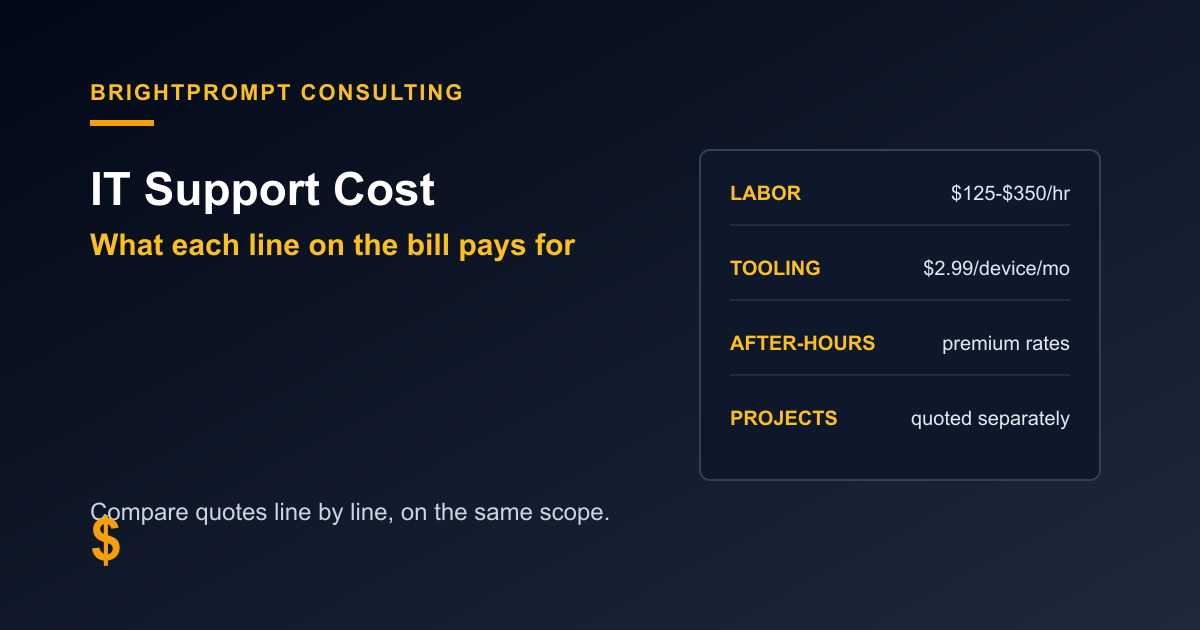
An IT support bill is usually four lines: labor billed by the hour, tooling charged per device, after-hours premiums, and project work quoted separately. A small business should expect break-fix labor at $125-$350 per hour, or $100-$400 per user per month on a managed plan, according to a 2026 small business IT pricing guide at fidelisnw.com. To compare two quotes fairly, put both on the same scope: the same included hours, the same after-hours terms, the same tooling, and projects priced on their own line.
What does an IT support bill include?
| Bill line | What it includes | What to ask before signing |
|---|---|---|
| Labor | Technician time for tickets, calls, remote work, and visits | Rate, billing increment, minimum charge, included hours, and travel treatment |
| Tooling | Monitoring, patching, backup, and remote-access software | Covered users and devices, included tools, per-device charges, and license ownership |
| After-hours | Work requested outside the standard service window | Coverage hours, response terms, premium rate, and minimum charge |
| Projects | Defined work such as a firewall replacement, migration, office move, or Wi-Fi redesign | Fixed or capped price, included hardware, acceptance criteria, and post-project support |
Before signing, ask the provider to fill in all four lines for the same users, devices, service window, and expected workload. Treat a blank line as an unanswered cost or scope question, not as an included service.
BrightPrompt monthly support cost calculator
Estimate BrightPrompt's published monthly support pricing. This is an estimate, not a quote.
Monthly support = $99 + max(0, hours - 1) × $129. Optional audit = $299. Displayed total = monthly support + optional audit.
The $99 retainer is charged even when usage is 0. Fractions above the included hour use the same $129 hourly rate for this estimate. Hardware, licenses, travel, after-hours work, taxes, and separately scoped projects are excluded.
What does the labor line cover?
Labor is the time a technician spends on tickets, calls, and visits. It's billed at an hourly rate or drawn from a monthly block of included hours. The fidelisnw guide puts hourly break-fix support at $125-$350 per hour, and it warns that the hourly line can grow past the rate itself. Hourly support, the guide says, "may add minimum service periods and travel, after-hours, parts, or project fees." Before you compare rates, ask for the billing increment. A provider that bills in 30-minute blocks charges you for 30 minutes when the fix took 10.
What does the tooling line pay for?
Tooling is the monitoring, patching, backup, and remote-access software that runs on each laptop, server, and network device. Providers usually pay for it per device, and many pass that cost through. Datto RMM, one common monitoring platform, starts at $2.99 per endpoint per month with a minimum of 10 endpoints or $29.90 a month, according to invenioit's 2026 Datto RMM pricing page. For a 30-device office, that's about $90 a month before any labor. If a quote has no tooling line, ask whether monitoring is included. A provider without monitoring finds out about a failed backup when someone complains.
How much does the after-hours premium add?
After-hours work is priced above the day rate, and the premium is the line that surprises most people. Stanford University publishes its rates for this. Its after-hours tier, which covers 5 p.m. to 8 a.m. on weekdays and any time on weekends, is $217 per technician-hour for installation and maintenance and $233 per technician-hour for service delivery. Its rush surcharge adds $284 per request when work has to start faster than the standard response time. A university price list isn't a small business quote, but it shows what a premium looks like when it's written down. Ask every provider for its after-hours number in writing.
When does project work show up on the bill?
Project work has a start and an end: a firewall replacement, a server migration, an office move, a Wi-Fi redesign. Most providers quote these as fixed prices, and that's usually the right way to buy them. The trouble comes from a project billed hourly with no cap, or a fixed price that leaves out parts. Confirm three things: whether the price is fixed or capped, whether hardware is included, and whether support after the project sits on the monthly plan or becomes new hourly work.
How do you compare two quotes like-for-like?
Take one month of work and price it both ways. The example below uses an illustrative 25-user office with 30 devices, 12 hours of ordinary support, 2 hours of after-hours work, and one $1,800 firewall replacement. Quote A is hourly break-fix at the $125 low end of the range. Quote B is a managed plan at $100 per user, also the low end. Treat the numbers as a worked example, not a quote from any real provider.
| Bill line | Quote A: hourly break-fix | Quote B: managed, per user |
|---|---|---|
| Ordinary labor (12 hours) | $1,500 | Included, if within plan scope |
| After-hours (2 hours at $217) | $434 | Confirm in contract |
| Tooling (30 devices at $2.99) | Not listed | Included |
| Monthly total, before project | $1,934 | $2,500 (25 users x $100) |
| Firewall project | $1,800 fixed | $1,800 fixed |
Quote A looks cheaper until you add the tooling it leaves out. With $90 a month of monitoring included, its monthly total is about $2,024. Against the $2,500 flat plan, the hourly quote wins only while labor stays low. At $125 an hour, it matches the flat plan once daytime labor reaches about 19 hours a month. Assuming no after-hours work, every month above 19 hours favors the flat plan, and every month below favors the hourly quote.
How do you read a quote before you sign?
Ask each provider to fill in the same four lines: labor, tooling, after-hours, and projects. Any blank line is a question to answer before you compare totals. The IT support price checklist lists eight things to confirm before you sign, and the hourly rate comparison for freelancers, agencies, and retainers shows how the labor line changes across provider types.
Frequently Asked Questions
What does IT support usually cost for a small business?
Break-fix labor runs $125-$350 per hour, and managed plans run $100-$400 per user per month, according to a 2026 pricing guide at fidelisnw.com. The total you pay depends on which lines the quote includes.
Why do two IT support quotes for the same office differ so much?
Usually the scope differs. One quote includes monitoring and a block of hours, while another bills every ticket and leaves tooling, after-hours work, and projects off the page. Compare the four bill lines before you compare the totals.
Are after-hours premiums normal?
Yes. Stanford University's published rate for after-hours installation and maintenance is $217 per technician-hour, and its rush surcharge is $284 per request. Ask your provider for its after-hours rate in writing, along with the hours that count as after-hours.
Should I pay per device for monitoring?
Per-device monitoring is common. Datto RMM starts at $2.99 per endpoint per month with a 10-endpoint minimum, according to invenioit. If you pay for it directly or inside a flat fee, ask which one the quote means.